How to Jump Start a Car
Jump start a dead car battery safely with jumper cables and a second car, in the right cable order, then drive long enough to recharge it.

With jumper cables and a second car, you will have the dead car running and the cables safely off in about 15 minutes, followed by a 30-minute drive to put charge back into the battery.
The cable order is the part to get right. Reversing the cables can blow fuses and damage control modules in either car, and making the last connection at the dead battery can spark right next to the hydrogen gas a battery gives off.
A set of jumper cables, which you should keep in your trunk at all times. Check them now and then, because clamps corrode and insulation cracks over time. You also need a second car with a working battery, plus eye protection and gloves, which AAA recommends whenever you use jumper cables.
Position the cars and turn everything off
Park the working car nose to nose or side by side, close enough that the jumper cables reach both batteries without stretching, and make sure the cars are not touching. Put both cars in park (or first gear for a manual) with the parking brake engaged. Turn off both engines and all accessories, including lights, radio, and air conditioning. Put on the eye protection and gloves, then pop both hoods and locate each battery. If you cannot find a battery under the hood, check the owner's manual, because some cars keep it in the trunk or under a seat. Before you connect anything, look at both batteries. If either case is cracked or leaking, do not jump it, as AAA warns, and call roadside assistance instead. AAA also says a swollen battery should be replaced, because a jump may not work. Do not jump a frozen battery or one with a low fluid level either. Mazda's owner's manual warns that either one can rupture or explode.
Connect the red cable to both positive terminals
Read the warning below before you pick up the cables. Pick up the red (positive) jumper cable. Clamp one end to the positive terminal on the dead battery. The positive terminal is marked with a plus sign and usually has a red cap or cover. Then clamp the other end of the red cable to the positive terminal on the good battery. Make sure the clamps have a solid grip on the metal terminal. Loose connections will not transfer enough power.
Heads up: Once any clamp is on a battery, never let the red and black clamp ends touch each other, and never let a loose red clamp touch bare metal on either car. Either one creates a short circuit that can damage the electrical system, blow fuses, or cause sparks near the battery. Keep the loose clamps apart until each one goes on.
Connect the black cable to the good battery, then to bare metal
Clamp one end of the black (negative) cable to the negative terminal on the good battery. The negative terminal is marked with a minus sign. The last connection is the one most likely to spark, so do not lean over either battery while you make it, as AAA advises. Do not connect the other end to the negative terminal on the dead battery. Instead, clamp it to a ground point on the dead car, so any spark happens away from the hydrogen gas that can collect around the battery. Use the point your owner's manual shows. Honda's manual names an engine mounting bolt and says not to connect the cable to any other part, and Mazda's marks the location in a figure. If your manual shows no point, use a solid, unpainted metal bolt or bracket on the engine, away from the battery. Keep the clamp and both cables clear of the cooling fan and the belts, because Mazda's owner's manual warns that a cable near moving parts can get caught when the engine starts.
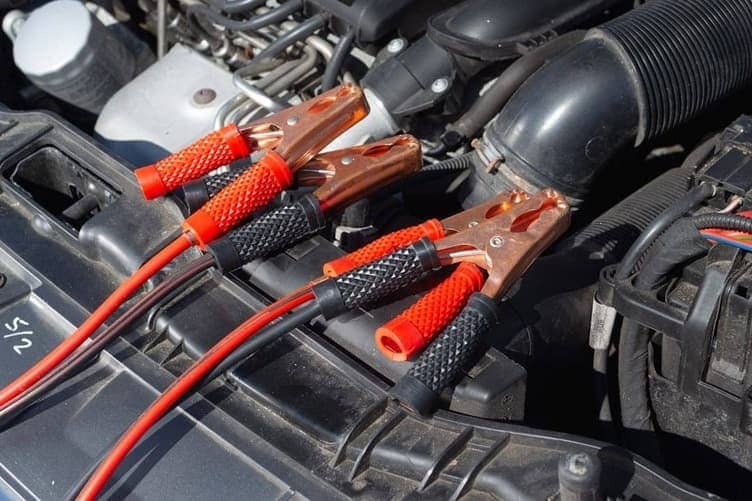
Good to know: Find the ground point in the owner's manual before you attempt a jump, as AAA advises. Painted or greasy metal makes a poor connection, so move the clamp if it sits on either. Honda's manual tells you to check for good metal-to-metal contact if the engine turns over slowly.
Start the working car and wait
Start the working car and let it idle for 5 to 10 minutes, as AAA advises. This puts charge into the dead battery before you ask it to turn the starter motor. If the dead battery seems badly depleted (the dashboard lights did not come on at all when you tried to start it), hold the donor engine at a fast idle. An alternator produces more current the faster its rotor spins, and Honda's and Mazda's owner's manuals both tell the assisting driver to raise the engine speed. Light steady pressure is all it takes, and flooring it does not help.
Start the dead car
Start the dead car. If it starts, let the working car drop back to a normal idle and go to step 6. If it does not start, check that every clamp has a solid grip, then wait another 3 to 5 minutes with the working car running and try again. If it still does not start after two or three attempts, stop cranking. AAA names the starter, the alternator, a blown fuse, a bad battery cell, or another electrical fault as the causes left at that point, and the next step is roadside assistance or a tow to a shop. FAQ 3 below explains how to tell a dead battery from the rest.
Disconnect cables in reverse order
Remove the cables in the exact reverse order you connected them. Keep each clamp away from the others and from bare metal until it is off, and keep the cables clear of the fan and belts, which are now moving. First, remove the black clamp from the ground point on the car that was dead. Then remove the black clamp from the good battery. Then remove the red clamp from the good battery. Finally, remove the red clamp from the previously dead battery. Drive the jump-started car for at least 30 minutes without turning it off, which is what AAA recommends. That is the alternator putting charge back in, and it does that faster at driving speed than at idle.
Heads up: If the car stalls during that drive, or will not restart after it, the battery is not holding a charge or the alternator is not charging it. Jump it again and take it to a repair shop to have the battery and charging system tested.
After the 30-minute drive, have the battery tested at a repair shop or auto parts store so you know whether it holds a charge before you rely on it again. If you are buying jumper cables, our guide on how to use jumper cables covers which gauge and length to buy, reading terminals under corrosion, and jumping in the rain. To skip the second car next time, get a portable jump starter if you often drive alone. It is small enough for a glove box, but read the heat warning in FAQ 4 below before you store it in the car.
Questions we get asked about this
Answers from experience, not a textbook.
Car batteries produce small amounts of hydrogen gas, especially when they are dead or being charged. Connecting the last cable directly to the battery terminal can create a spark, and a spark near hydrogen gas can cause the battery to explode. Clamping to a ground point away from the battery instead keeps any spark away from that gas. AAA gives the same instruction. Use the point your owner's manual shows, because some manufacturers allow only one, and step 3 covers what to clamp when the manual shows none.
You can if you reverse the cables. Clamping red to a negative terminal can blow fuses and damage control modules in either car. Check the plus and minus marks before each clamp goes on, follow the order in steps 2 and 3, and let the working car return to a normal idle before you disconnect anything.
If you turn the key and hear rapid clicking but the engine does not turn over, the battery is likely dead. If the dashboard lights come on dim or not at all, that also points to the battery. If the lights and radio work normally but nothing happens when you turn the key, suspect the starter motor, a blown fuse, or a loose connection. If the engine cranks normally but does not start, the problem is probably not the battery. It could be fuel, spark plugs, or something else entirely.
Yes. A portable jump starter is a compact battery pack with its own clamps that starts the car without a second vehicle, and AAA recommends one if you often drive alone or travel remote routes. Buy one with enough peak or cranking amps for your engine size, plus reverse-polarity and spark protection. AAA notes that many also come with USB ports for charging phones and other devices. Before you leave one in the glove box, check the storage temperature range in its manual. A car parked in summer sun can get hotter than lithium packs are rated for, so in hot weather it may belong in the house rather than the car.
Check the owner's manual before you connect anything. Hybrids and EVs still carry a conventional 12-volt battery for the electronics, and a flat one will stop the car from starting even when the main traction battery is full. The designated jump points are often not the battery itself, and several manufacturers specify their own procedure. Some also prohibit using the vehicle to jump someone else, because the DC-to-DC converter is not built to deliver starter-motor current. Follow the manual's procedure instead of the steps above, and never connect cables to the high-voltage system, which AAA also warns against.
Car Owner Essentials
How to Check Tire Pressure
How to Change a Tire
How to Change Your Oil
How to Check Your Oil
How to Jump Start a Car
← you’re hereHow to Parallel Park
How to Use Jumper Cables