How to Swim
Go from standing in the shallow end to floating on your back, kicking, breathing to the side, and swimming your first 25 yards without stopping.

You will go from standing in the shallow end to floating on your back, breathing to the side, and swimming 25 yards without stopping, with a lifeguard on duty and a buddy nearby the whole time.
A 2014 Red Cross survey found that more than half of Americans, 54%, either cannot swim or cannot perform all five of the basic swimming skills. The Red Cross calls those five water competency: step or jump into water over your head, return to the surface and float or tread for 1 minute, turn in a full circle and find an exit, swim 25 yards to it, and get out of the water. In that same Red Cross survey, 80% of Americans said they could swim, and only 56% of those could perform all five.
Fear is a common obstacle. In the same survey, 46% of Americans said they had been in the water and afraid they might drown. That is why step 1 spends a whole pool session on comfort before any swimming.
Access to a pool with a shallow end where you can stand. This is essential for beginners. A pair of swim goggles. An inexpensive pair works for learning. A swimsuit you are comfortable moving in. A kickboard for step 3, and ask at the front desk whether the pool lends them before you buy one. A swim cap if you have longer hair. Ear plugs if water in your ears bothers you.
Get comfortable being in the water
Before you get in, follow the two rules that matter more than anything else on this page. The Red Cross says to swim in designated areas supervised by lifeguards, and to always swim with a buddy rather than let anyone swim alone. That holds for strong swimmers too, and even more for someone practicing a skill they do not have yet. Do not teach yourself to swim in an empty pool. Start in the shallow end where you can stand with your head fully above water. Walk around. Get used to the resistance of moving through water. Submerge to your shoulders and stay there for a few minutes. Then practice putting your face in the water for a few seconds at a time. Blow bubbles through your nose or mouth while your face is submerged. It teaches you to exhale underwater, which prevents the panicked breath-holding that makes everything harder. Spend an entire pool session just getting comfortable before trying to swim.
Good to know: Wear goggles from day one, so you can see the wall, the floor, and your own hands with your face in the water.
Learn to float on your back
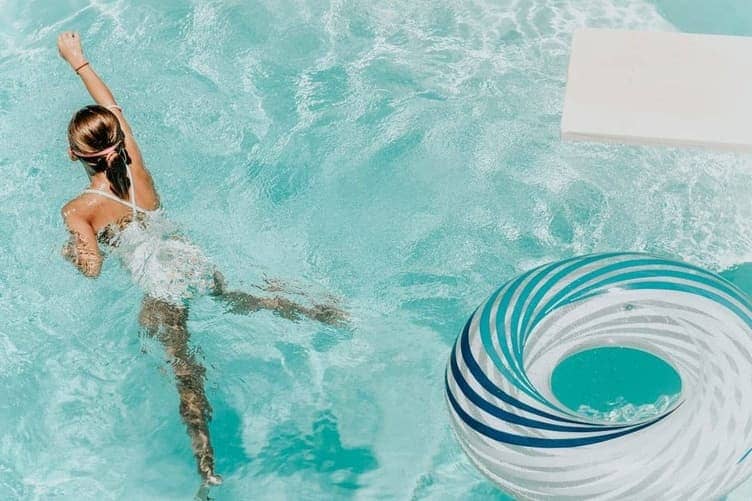
Stand in waist-deep water. Lean back slowly and extend your arms out to the sides. Push your hips toward the surface and let your feet float up. Keep your head back with your ears in the water and your chin slightly up. Look at the ceiling. The natural instinct is to lift your head, which sinks your hips and legs. Fight that instinct. Most of your buoyancy sits in your chest, where your lungs are, so your position decides whether your legs stay up. If your legs keep sinking, add a gentle flutter kick to keep them near the surface. Practice this until you can float on your back for 30 seconds without support, then build to 1 minute, the float time in the Red Cross water competency skills in the intro. This is your safety position. If you ever get tired or panicked in the water, rolling onto your back lets you breathe and rest.
Practice kicking with a kickboard
Hold a kickboard in front of you with both hands, arms extended. Push off the wall gently and kick from the hips with nearly straight legs. Keep your toes pointed and your kicks small and fast rather than big and splashy. Big kicks waste energy and slow you down. Your knees should bend slightly, but the power comes from your hips, not your knees. Practice kicking across the pool and back. This builds leg strength, teaches you how propulsion works in water, and keeps your face near the surface where you can breathe easily. Once you are comfortable, put your face in the water while kicking, and lift it to breathe every few seconds.
Learn to breathe while moving
The technique is simple in theory. Exhale underwater through your nose or mouth, then turn your head to the side to inhale when your mouth clears the surface. In practice, the timing takes repetition. Start by holding the pool wall with both hands, putting your face in the water, blowing bubbles steadily, then turning your head to the side to breathe. Repeat this 20 times. Then do it while kicking with a kickboard. Put your face in, blow bubbles for three kicks, turn your head to the side, inhale, put your face back in. The key is to exhale continuously underwater so your lungs are mostly empty when you turn to breathe. If you try to exhale and inhale in the brief moment your mouth is above water, you will feel rushed and panicked.
Heads up: Never hold your breath underwater while swimming. Carbon dioxide builds up in your blood while you hold it, and rising blood CO2 is what drives the urge to breathe, so holding on creates exactly the desperate gasping feeling that causes panic. Blow a steady stream of bubbles the entire time your face is submerged. Breathing out is more important than breathing in. If you exhale properly, the inhale happens naturally.
Add arm strokes to make full freestyle
Start kicking with your face in the water, arms extended in front of you. Pull one arm down through the water alongside your body, bending your elbow, then lift it out of the water and reach it forward again. As that arm reaches forward, pull the other arm. This alternating motion combined with your kick is the freestyle stroke. Turn your head to the side to breathe when the pulling arm is at your hip. Breathe on one side consistently until you are comfortable, then practice breathing on both sides. Start with short distances. Swim to the middle of the pool and back rather than trying a full lap immediately.
Build endurance gradually
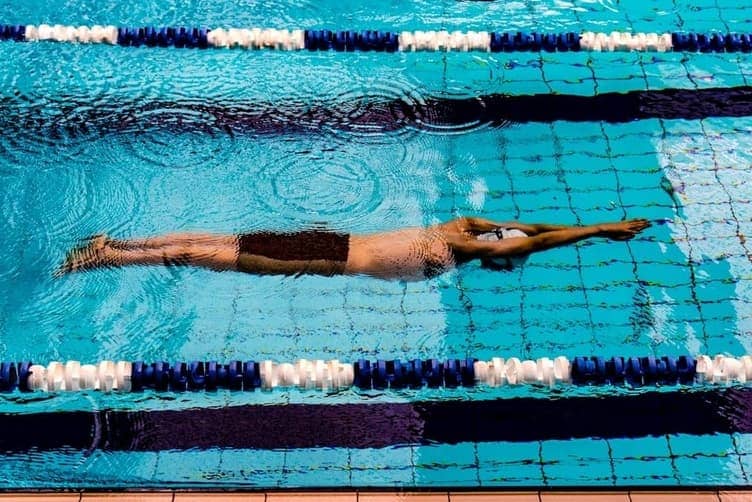
Your first full lap will feel exhausting. That is normal. Swimming uses muscles in combinations your body is not used to, and breathing technique is still developing. Swim as far as you can, rest for 30 seconds, and go again. Build up gradually over sessions. Your first distance goal is 25 yards without stopping, the swim distance in the Red Cross water competency skills and one length of a 25-yard pool. Swim slowly and keep your body long and flat in the water, because a sinking hip or a splashing kick adds drag, and time each breath with the arm stroke from step 5.
Once you can swim 25 yards without stopping, work through the other four Red Cross water competency skills from the intro in the deep end, with a lifeguard on duty and your instructor or buddy beside you. Keep going 2 to 3 times a week, and if one stage stalls for several sessions, book a lesson so an instructor can see what you cannot feel. When you want to take those skills outdoors, our guide on how to surf in the same series starts with paddling out.
Questions we get asked about this
Answers from experience, not a textbook.
No. The Red Cross runs its Learn-to-Swim program for people of all ages, so call your local pool or rec center and ask whether it runs a beginner class for adults. To get past the fear the intro describes, go to the pool regularly and repeat step 1 until putting your face in the water feels routine.
There is no measured answer to this, and any precise session count you are quoted is a guess. The progression is more useful than a total. You get comfortable in the water first, then floating and kicking, then arm strokes and breathing on top of those, and none of those stages can be skipped. Go 2 to 3 times a week so there are no long gaps between sessions.
Take lessons, especially if you are anxious in water. Look for an instructor certified as a Red Cross Water Safety Instructor (WSI). An instructor can identify and fix technique issues that you cannot feel yourself, like dropping your elbow during a stroke or kicking from the knees instead of the hips. Start with a group beginner class, where you are standing next to other adults at the same level. What they actually cost varies between cities and facilities, so call your local pool or rec center rather than trusting a number off the internet.
Your legs are denser than your upper body because muscle and bone are heavier than fat and lung air. This is normal. To counteract it, press your head back slightly (look at the ceiling, not your feet), spread your arms wide for balance, and engage a light flutter kick. Pushing your hips toward the surface also helps. Over time, your body learns the right position and floating requires less effort.