How to Surf
Surf your first day as a complete beginner. Practice the pop-up on the sand, read where waves break, paddle out, and ride whitewash to shore on a soft-top board.

You will end up standing up on a soft-top board and riding broken whitewash toward the beach, which is the realistic goal for a first day. You will get there by practicing the pop-up on the sand, reading where the waves break, paddling out, and catching whitewash, and you will spend most of the day falling off.
Surfing is hard to learn because the water and the board both move under you while you make a fast movement from lying down to standing, and you make it tired from paddling. Expect to swallow some ocean.
Before you go in, make sure three things are true. You surf at a beach with lifeguards, which the National Weather Service says is the only kind of beach to swim at. You do not surf alone. And you can swim in the surf, not only in a pool, because the United States Lifesaving Association warns that pool swimming is not the same as swimming at a surf beach. If you are not there yet, start with our guide on how to swim.
A soft-top surfboard at least 8 feet long (longer boards are more stable and easier to catch waves on). Rent one from a local surf shop near the beach. You also need a wetsuit if the water is cold, and the shop renting you the board can tell you what thickness the local water calls for. Surf wax for grip if using a hardboard (soft-tops have built-in traction). A leash that attaches the board to your ankle. Sunscreen, and the label matters more than the number here. The American Academy of Dermatology says to look for three things: broad spectrum, SPF 30 or higher, and water resistant, and it notes that water resistance lasts either 40 or 80 minutes. SPF 50 is fine, but a high number on a sunscreen that washes off in your first half hour is worth less than a water-resistant 30. Put it on before you leave the house and reapply when you come in for a break, because a 2-hour session outlasts the water resistance on any bottle sold. If you surf without a wetsuit, add a rash guard, which stops the wax and the board from rubbing your chest and stomach raw.
Start on the beach with your pop-up
The pop-up is the movement that takes you from lying on the board to standing on it. Practice it on the sand before getting in the water. Lie face-down on the board with your hands under your shoulders, like a push-up position. In one smooth motion, push up, bring your back foot forward to where your hips were, and plant your front foot between your hands. You should end in a low, wide stance with your knees bent, feet shoulder-width apart, and your body turned slightly sideways. Your front foot should point toward the nose of the board at a slight angle. Practice this 20 to 30 times on the sand until the motion feels natural. Speed matters here. A slow, hesitant pop-up will not work on water.
Good to know: Never grab the rails (sides) of the board during your pop-up. It tilts the board as you stand. Keep your hands flat on the deck, push straight up, and slide your feet into position.
Learn to read the waves
Before paddling out, spend 10 minutes watching the waves. Start with rip currents. The United States Lifesaving Association says to assume they are always present at surf beaches, and its clue to look for is a narrow gap of darker, seemingly calmer water between areas of breaking waves and whitewater. Do not paddle out in or next to that gap, and ask the lifeguard where the rips are running that day. Then look for where the waves break consistently. Waves break when the water gets shallow, so they break in the same spots. Look for the whitewash (the foamy white water after a wave breaks). As a beginner, you will ride the whitewash, not the unbroken green waves. That comes later. Notice the time between sets (groups of waves). Sets arrive with calmer gaps between them, so paddle out during a gap. Watch where experienced surfers sit and catch waves, and stay out of that area. As a beginner, you belong in the whitewash closer to shore.
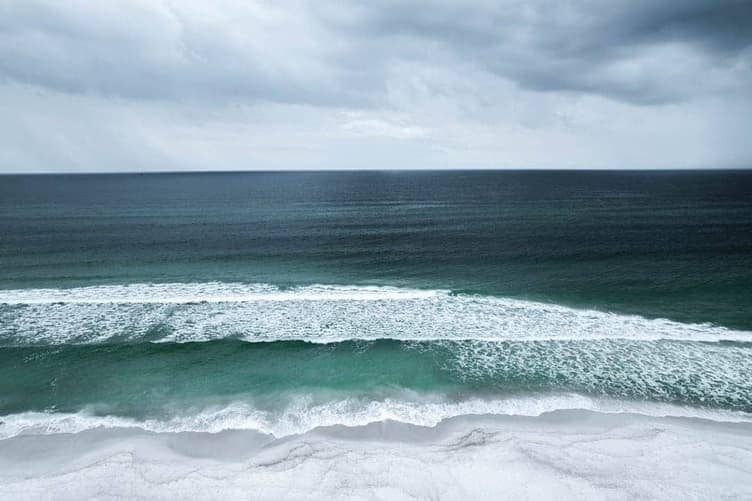
Paddle out to waist-deep water
Strap the leash to the ankle of your back foot before you walk in. Carry your board into the water until it is about waist-deep. Lie on the board with your body centered, nose of the board slightly above water. If the nose digs underwater, scoot back a few inches. If the nose is too high, scoot forward. Paddle using alternating arm strokes, reaching forward and pulling through the water alongside the board. Keep your fingers together and cup your hand slightly. Paddle out past where the whitewash is breaking so you have room to turn around and catch it. As a beginner, stay in waist-deep to chest-deep water where you can stand up if you fall.
Catch your first whitewash wave
Turn your board toward the beach. Look over your shoulder and wait for a line of whitewash to approach. When it is about 5 feet behind you, start paddling hard toward shore. You need to match the speed of the wave before it reaches you. When you feel the wave pick up the tail of your board and start pushing you forward, take two more strong paddle strokes, then do your pop-up. Do not hesitate. If you wait too long, the wave passes under you. Commit to the pop-up the moment you feel the push.
Heads up: Keep your weight centered and low when you stand up. The mistake to watch for is standing too tall and too far back on the board. Stay low in your stance with knees bent and your weight over the center of the board. Standing tall raises your center of gravity and makes every wobble a wipeout.
Ride the wave and steer
Once you are standing, look where you want to go, not down at your feet. Looking down shifts your weight forward and throws off your balance. Your body follows your eyes. To turn, shift your weight gently onto your toes to turn toward the side you are facing, or onto your heels to turn the other way. Keep your arms out for balance, knees bent, and your stance wide. The ride on a whitewash wave is short. That is normal and that is a success. Ride it as long as you can. When it slows, step off the board feet first and never dive off headfirst, because you cannot see how shallow the water is.
Fall safely and respect the water
You will fall a lot. When you do, fall flat rather than diving, and come up with your arms over your face and head. Your board stays attached to your ankle by the leash, so when a wave hits it, it can snap back toward you. Never paddle out directly behind another surfer. If they fall, their board comes straight at you. Stay to the side. Follow basic surf etiquette. The person closest to the breaking part of the wave has the right of way. Do not drop in on someone already riding a wave.
Between sessions, practice the pop-up on the floor at home until you land in the same low stance every time, because every wave you catch in step 4 depends on it. If you have not booked a lesson yet, book one for your next session (FAQ 4 below). Go out early in the morning, before the afternoon sea breeze roughens the surface, and before you go in, check the local beach forecast and talk to the lifeguard, as the National Weather Service advises. On flat days, practice balance and stance on a skateboard. Our guide on how to skateboard covers the beginner basics.
Questions we get asked about this
Answers from experience, not a textbook.
These are instructor rules of thumb rather than measured figures. Riding whitewash (already broken waves) usually comes in the first session or two. Catching and riding unbroken green waves consistently takes many more sessions, spread over weeks or months. Becoming a confident intermediate who can read waves, navigate lineups, and ride along the face of the wave is a matter of years of regular surfing. Progress depends heavily on how often you surf and the quality of waves available to you.
An 8- to 9-foot soft-top foam board. Longer, wider boards are more stable, catch waves more easily, and give you more time to stand up. Short boards (under 7 feet) are for experienced surfers. They are fast and maneuverable but much harder to balance on and catch waves with as a beginner. Rent the long board even if it looks less exciting.
Yes, and the serious risk is the water rather than the board. On a beginner day you will collect cuts and bruises from your own board, the odd reef scrape, and the occasional jellyfish sting. Rip currents are what drown swimmers and surfers, and the United States Lifesaving Association says they account for over 80% of rescues performed by surf beach lifeguards, which is why FAQ 5 below covers them. The safety rules are: surf at a beach with lifeguards, surf within your ability, never surf alone, check for rip currents before entering, and cover your head when you surface after a wipeout. Starting with a soft-top board also reduces the risk of board-related injuries.
Yes, for your first session. A surf instructor will choose the right spot for conditions, push you into waves at the right moment, and correct your pop-up technique in real time. Self-teaching surfing is possible but inefficient because you cannot see what you are doing wrong. Book a group lesson unless you want one-on-one coaching. It costs less than a private lesson, but prices vary by country, beach, and season, so ask the surf schools where you are going, and ask whether the price includes the board and wetsuit rental.
NOAA's instruction is blunt. If you are caught in a rip current, do not fight it, but swim parallel to the shore and then back to land at an angle. NOAA also explains why fighting it is the dangerous part. Panicked swimmers try to go straight back to shore and risk drowning from fatigue. Rip currents can move at up to 8 feet per second, faster than an Olympic swimmer, and NOAA estimates they kill about 100 people a year in the United States. A rip current is a narrow channel of water flowing away from the beach. On a surfboard you already have a float, so stay on it and paddle parallel to the shore. If you cannot get out of the current, relax, because a rip current does not pull you under, and float or tread water. The United States Lifesaving Association notes that some rip currents circulate back toward shore, while others end just beyond the breaking waves or keep flowing hundreds of yards offshore. If you need help, yell and wave for assistance. Before surfing any new beach, ask locals or lifeguards about rip current locations.