How to Do a Pullup
Build from zero to your first unassisted pullup with dead hangs, scapular pulls, slow negatives, and band-assisted reps, then add reps with the grease-the-groove method.

You will end up doing your first unassisted pullup, built from four exercises you can do on any bar: dead hangs, scapular pulls, slow negatives, and band-assisted pullups. A pullup uses your lats, biceps, forearms, and core together, so the progression trains each part of the movement before you attempt the whole thing.
Train three times a week. How many weeks it takes depends on your starting strength and body weight, and FAQ 1 below explains why no one can promise a number. You need no gym membership, only a bar you can hang from and a resistance band.
A pull-up bar. Door-frame-mounted bars are inexpensive, and many fit without screws, but check the bar's weight rating and that your door frame suits it before you hang from it. Park fitness stations and playground monkey bars also work. A resistance band (long loop style, not the short ones) for assisted pullups. A medium band is a good starting point. Colors are not standard between brands, so go by the assistance rating printed on the band. You can also use a sturdy chair for assisted variations.
Start with dead hangs
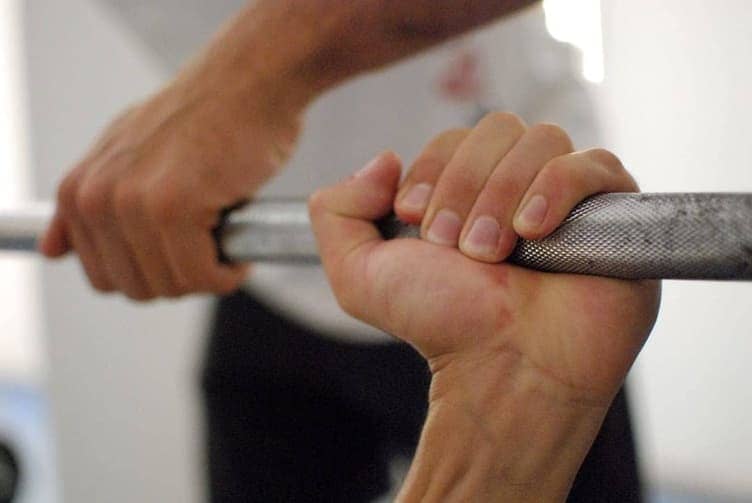
Grab the bar with an overhand grip (palms facing away from you), hands slightly wider than shoulder-width. Hang with straight arms and your feet off the ground. Hold for as long as you can. If your first hang lasts only 10 seconds, that is fine. Do three sets of your maximum hold time with 60 seconds rest between sets. Practice this three times a week. Dead hangs build grip strength and forearm endurance. You cannot do a pullup if you cannot hold onto the bar. Add a few seconds each session until you can hold a 30-second hang.
Good to know: Engage your shoulders during the hang by pulling your shoulder blades slightly down and back. This is called an active hang and it trains the muscles at the very start of the pullup movement. Alternate between passive hangs (fully relaxed) and active hangs.
Do scapular pulls
Hang from the bar with straight arms. Without bending your elbows, pull your shoulder blades down and together. Your body will rise 1 or 2 inches. Hold for 2 seconds, then relax back to a dead hang. This small movement trains the first phase of the pullup. Do three sets of 8 to 10 reps. The movement is subtle. Think about putting your shoulder blades in your back pockets.
Train with negatives
Use a chair or jump to get your chin above the bar. Hold at the top for 1 second. Do not let yourself drop into the bottom position, because the slow lowering is the part that builds strength. Lower yourself as slowly as possible, taking 5 to 8 seconds to reach a full dead hang at the bottom. This is a negative or eccentric pullup, and it builds pulling strength through the entire range of motion. Your muscles are stronger during the lowering phase than the lifting phase, which is why you can do this before you can do a full pullup. A 2023 meta-analysis in Sports Medicine pooling 335 studies and 12,546 people put upper-body eccentric strength at about 1.42 times concentric strength. Do three sets of 3 to 5 negatives. If you cannot lower slowly for the full range, lower as far as you can control, then put your feet back on the chair. Aim to control a little more of the range each session.
Heads up: If you cannot lower slowly for even 2 seconds, go back to dead hangs and scapular pulls for another week, then try negatives again.
Add band-assisted pullups
Loop a long resistance band over the pull-up bar and step one foot or knee into the bottom of the loop. The band supports some of your body weight, reducing the load your muscles need to move. Grip the bar with an overhand grip and pull yourself up until your chin clears the bar. Lower slowly (3 seconds down). Do three sets of 5 to 8 reps. As you get stronger, switch to a thinner band with less resistance. The goal is to gradually reduce the assistance until the band is providing almost nothing and you are doing the work.
Attempt your first unassisted pullup
When every negative takes you 5 to 8 seconds and you can do sets of 5 to 8 band-assisted reps with your lightest band, try one full pullup without assistance. Grip the bar, engage your shoulders, and pull. Drive your elbows down toward your hips. Think about pulling the bar to your chest rather than pulling yourself to the bar. If you get halfway up and stall, that is progress. Go back to band-assisted reps at the lightest band and negatives for another week.
Build from one to multiple reps
Once you can do one, build volume with a method called grease the groove. Throughout the day, every time you pass the bar, do one clean pullup, and stop well short of failure. The single reps add up to more pulling in a day than one hard set, without leaving you exhausted. When one rep feels easy, do two each time, then three. After that, switch to structured sets, such as three sets of 5 reps with rest between.
If a stage stops improving, go back one stage for a week, with more negatives and band-assisted sets, then test again. If your shoulders or elbows hurt during a pull, as opposed to feeling tired, stop and rest before your next session. On your rest days, build the core strength that keeps your body from swinging on the bar with our guide on how to do a plank, which takes you from a shaky 15 seconds to a solid minute.
Questions we get asked about this
Answers from experience, not a textbook.
We could not find a study that measured how long it takes to go from zero to one pullup, so we will not give you a week count. Your starting strength, your body weight, and how consistently you train all change it. Use the checkpoints in the steps instead: 30-second dead hangs, 5 to 8 second negatives, then sets with your lightest band. Try an unassisted rep when you reach the last one.
Grip direction. Pullups use an overhand grip (palms facing away). Chin-ups use an underhand grip (palms facing you). Chin-ups are slightly easier because they involve the biceps more directly, which adds pulling power. If pullups stall, practice chin-ups as an intermediate step, because the lat work is similar in both movements.
Yes. The progression is the same, but expect it to take longer, because you are pulling more body weight. Band-assisted pullups are especially useful, because you can pick a band thick enough to make the load manageable. Losing weight makes pullups easier (less load to move), but waiting until you lose weight is not necessary. Start the progression now.
For the grease-the-groove method (single reps throughout the day, never near failure), daily practice works well. For hard sets taken to or near failure, leave at least a day of rest between sessions and train three times a week, as the steps do. That schedule sits above the Physical Activity Guidelines for Americans floor of muscle-strengthening activity on 2 or more days a week. If your shoulders or elbows feel sore or stiff, take an extra rest day.
Start with flexed-arm hangs using a chair. Stand on the chair, grip the bar, and hold your chin at or above bar height for as long as you can. This builds grip and arm strength in a position where you are supporting less than your full body weight. Also work on dead hangs for maximum time. Even 5-second hangs repeated for multiple sets build grip strength.
Mind & Body Balance
How to Do a Plank
How to Do a Pullup
← you’re hereHow to Meditate